I‘ve been writing about personal finance for just over 11 years now.
During that time I’ve written about Dave Ramsey and his “Financial Peace University” class, but I realized that I’ve never written a general review of his 7 baby steps plan to getting your finances in order and on track.
So today I’ll be writing a post about his baby steps plan and what I think of it.
NOTE: This article is only a general overview of the 7 basic principles of Ramsey’s Baby Steps, and is not intended to replace his full look at the 7 steps or his FPU course in part or in full. I am not affiliated with Dave Ramsey or the Lampo Group in any way. You can find Ramsey’s free online discussion of the 7 Baby Steps here.
Quick Navigation
Who Is Dave Ramsey?

So first of all, who is Dave Ramsey, and what are the 7 Baby Steps?
Dave Ramsey is a personal money management expert, radio talk show host and TV personality who over the years has helped thousands of people become debt free and change their financial lives.
He gives no-nonsense advice to folks who have gotten in over their heads, and helps them to find their way out, in a responsible way. If you’re afraid of hard work, you may want to look elsewhere for your advice.
In addition to his best selling books and radio and TV shows Ramsey also teaches “Financial Peace University” at huge live events, and the 7 Baby Steps are an offshoot of the FPU class.
So what are the 7 Baby Steps?
Dave Ramsey’s 7 Baby Steps
On his website Dave Ramsey lists what his 7 Baby Steps to financial freedom are:
- Baby Step 1 – $1,000 to start an Emergency Fund
- Baby Step 2 – Pay off all debt using the Debt Snowball
- Baby Step 3 – 3 to 6 months of expenses in savings
- Baby Step 4 – Invest 15% of household income into Roth IRAs and pre-tax retirement
- Baby Step 5 – College funding for children
- Baby Step 6 – Pay off home early
- Baby Step 7 – Build wealth and give!
For a more in depth discussion of the baby steps, head over to Ramsey’s site.
The baby steps basically involve planning ahead for emergencies, paying off debt and then planning for the future in a variety of ways. They also look at the importance of giving.
Even though a lot of these points may seem like common sense to a lot of people, for some they just don’t think about doing these things if they haven’t actually been told how to do them.
Before The Baby Steps: Making A Decision To Change
Before you even decide to head down the road of using or exploring the 7 Baby Steps, I think it’s important to point out just how key it is that you sit down, talk with your significant other (if you have one), and actually make a decision that you want to change.
A lot of people talk about how to change their financial lives, but never touch on the fact that if you or your spouse isn’t ready to change, it isn’t going to happen. You have to want to change.
I know for my wife and I there wasn’t one moment where we decided that we wanted to change, it was just a gradual realization that we weren’t spending our money as wisely as we should, that we were accepting too much debt as a part of our financial plan, and that we craved the freedom of not carrying any kind of debt. We wanted to be free!
Getting to the point where you want to change might mean that you’ve hit bottom and declared bankruptcy, or it might just mean that you’re sick of not saving enough towards retirement. It’s a different point for everyone. But when you get there you’ll know.
Before The Baby Steps: Make A Decision For No More Debt
Once you’ve made a decision to change, you need to be able to begin the change immediately and make a decision as a family that you aren’t going to incur any more consumer debt.
Credit cards and home equity lines of credit are off limits now. No more high interest auto loans!
If you want a new TV or a new kitchen countertops, you’re going to have to save for them.
No more store credit cards to buy clothing at ridiculous interest rates!
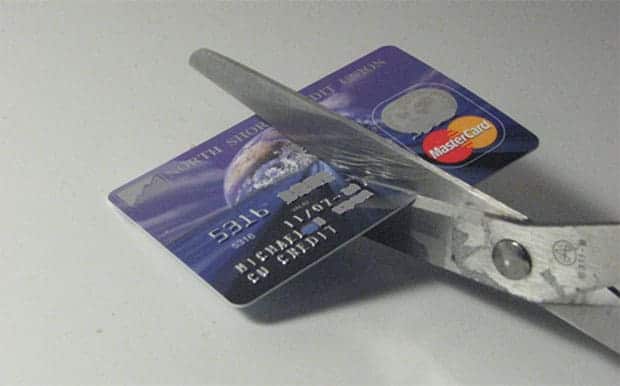
Cut up your credit cards, and draw a line in the sand. No more debt!
My wife and I used to use our credit cards in a variety of ways. We would use them to pay for vacations because we wouldn’t plan ahead and save up for them in advance.
We’d use them as a safety net for our household, instead of saving up a cash emergency fund.
If we needed new furniture we would just finance it at the store, and pay it off over time.
Once we made a decision to change, we realized that we couldn’t do that any more. We had to make a life change.
Using the 7 Baby Steps we were able to make a change in the way we looked at money, and in the process change our lives for the better.
So let’s do a review of what is involved with Ramsey’s baby steps, and what I think of them (even if the previous sentence clued you in to the fact that I’m a fan!).
Baby Steps: Getting Rid Of Existing Debt
After saving a small emergency fund one of the very first things you’ll be doing in the baby steps plan is working on paying off all of your debt.
Dave Ramsey is a proponent of his plan for paying off debt called the “Debt Snowball“. Basically you order your debts from smallest to largest, and pay them off in that order. By doing this you can optimize the effect of getting quick victories by paying off the smaller debts faster.
Some people would say that the Debt Snowball isn’t mathematically the best way to pay off debt, that something like the Debt Avalanche (highest interest first) method would be better.
Personally I’m in favor of using some sort of a hybrid debt repayment plan where you pay off some of your smaller debts first and then re-arrange your higher dollar debts to pay them off in the order of higher interest first.
Whatever you do to pay off your debt, it’s important to make a plan of some sort, make a budget and stick to it.
Baby Steps: Planning For The Future
In baby steps 3 through 7, Ramsey explores setting savings, investment and college savings goals, as well as talking about the reasons for why we should be building wealth, to be able to be free from debt burdens, and be able to give more to others. Baby steps 3-6 happen can all be done at the same time.
The general ideas he talks about are all sound in my opinion, even if his reasoning in the details isn’t always something I can agree with 100%.
Saving, Investing, Giving
Baby step 3 looks at saving a 3-6 month emergency fund – in other words saving up enough money to cover just about any emergency that could come up from a broken down car to a job loss.
I’m a big proponent of emergency funds, and as such I think this is a great idea. At our house, however, we decided to have an even larger emergency fund with 8-12 months in savings. In this economy we just felt better having more money than Ramsey states you should have.
After you’ve set up a contingency plan for the present Ramsey suggests looking at the future. He suggests investing 15% of your income into a Roth IRA or pre-tax retirement accounts.
While I can agree that saving 15-20% of income for retirement is definitely sound advice, I’m not always in agreement with Ramsey when it comes to the assumptions he makes about getting a 12% return in the stock market, or about what types of mutual funds to invest in. I think Ramsey’s advice has been shown to be a bit suspect in this area – and should be taken with a grain of salt.
Next Ramsey suggests saving up for your kid’s education – only after saving for your own retirement. I think this is sound advice as your child can pay for their education via loans or grants, but you probably won’t be able to do the same to fund your retirement. He suggest saving up in an ESA or similar account, while I think some other options like saving for college in a Roth IRA should be considered.
When it comes to homes and real estate Dave Ramsey has some pretty strict rules about what kind of mortgages he thinks you should get, what percentage of your income you should spend on a home, and how you should work to pay it off.
Ramsey suggests trying to pay off your mortgage early if at all possible after saving for retirement, your kids college and other necessary expenditures. I think having a paid off home is a great idea and it’s a great hedge against uncertainty in today’s environment. While I don’t agree with his statement that you should only ever get a 15 or fewer year fixed mortgag, I do think his advice about homes and real estate is pretty sound.
Of course I’m not following it completely with our 30 year mortgage, but we are making extra payments in order to pay it off early.
After doing all those other things – saving, investing, college funding, mortgages – Dave says you move on to the mythical 7th step where you just continue building wealth, and giving a large percentage of what is left over.
I think the giving portion should be stressed as it is such an important part of this. We’re all happiest when we’re giving to other people, and building wealth for wealth’s sake is pretty pointless. I’m glad he points out that giving is so important, and I’m glad that he points out that money and wealth won’t make you happy, but having a personal relationship with Christ, and giving as he did, will.
The Baby Steps – Sound Advice For Changing Your Financial Future
Dave Ramsey’s 7 Baby Steps are a debt management process that I became familiar with while i was taking Dave Ramsey’s Financial Peace University™ course a couple of years ago. I believe the process it lays out is a sound one whereby you plan for the present through emergency funds, you pay off your debts incurred in the past, and then you set about planning for your own and your family’s future.
I do think that there are certain points of the plan where I don’t have 100% agreement with Ramsey, especially when it comes to investing assumptions and methods, as well as college savings plans, but overall when you look at his plan with a 10,000 foot view, I think the ideas behind it are sound.
I would recommend using the 7 Baby Steps if you’re looking for a good debt management course, when used in conjunction with Ramsey’s Financial Peace University™ class (which I’ve found to be well worth the minimal cost).
For a full look at Ramsey’s 7 Baby Steps, head on over to his site: 7 Baby Steps
More Dave Ramsey Focused Content
- Unboxing Dave Ramsey: Opening the Financial Peace University™ Membership Kit
- Financial Peace University™ Review
- EveryDollar Review: The Dave Ramsey Budget App
- Why Dave Ramsey’s 7 Baby Steps Really Work
- Debt Snowball – Pay Off The Smaller Debts First
- Dave Ramsey Explains Why The Debt Snowball Works
- To Debt Snowball or Debt Avalanche, That Is The Question
- Dave Ramsey’s Plan For The Economic Crisis
- A Way To Control Spending: The Envelope System
- Drive Free Cars And Retire Rich
- How Much Of An Emergency Fund Do You Need?
- Dave Ramsey’s New House: Did He Follow His Own Advice And Pay Cash?
- Dave Ramsey Comments On My Post About His New House, His Debt Philosophy And Giving



I must take exception to Dave’s rule 5. College education is near critical for your child’s future. If you have to cut her, try a community college for a couple of years. You will save tens of thousands in cash or debt.
Bill Muhlenfelds last blog post..The College Credit Card Trap
What is more important retiring with dignity or sending your child to school? I’d rather not eat dog food when I’m retired.
In christianity, you have the rite to give up your rites.
That said, I think for most liberal arts stuff, we have a glut of college educated.
College for Kids is a luxury, Retirement is a necessity (Says Dave Ramsey) and I agree. Your kiddo can work through college, he/she will be young. That won’t kill him/her. Were as not having enough resources to retire can actually kill you.
DM
Better to raise a child with good character and a good education, the better to qualify for scholarships. And working to fund your own education builds character.
Please do more research…..and you won’t take exception to Baby Step 5.
Dave Ramsey is VERY opposed to sending your kid to a college that you cannot afford. He is 100% opposed to borrowing money to go to college, and recommends a community college or state university long before spending $200k on an education.
YES! unless your kid is set with a (nearly) free scholarship to a private or out of state school, don’t use personal debt to needlessly pay for your child to go to college. A bachelor’s degree is generally worth the paper it’s printed on. It opens limited doors on its own. It DOES put you in a different hiring poo however; light years above high school grads. If you are pursuing a career that requires higher education (psychology, biology etc), SAVE YOUR $ for a higher grade graduate school. THAT degree will make much more use of itself.
College for your children: My husband and I still don’t have enough money – long story – did the Ramsey thing and we are out of debt except for medical and house. But our son went to school based on his grades. He got full scholarships (not sports) and state grants and he is debt free right out of college! He has a good job and can pay all his bills! Hard work does pay off and what were his parents’ contribution? A home to live in while he attended the local university, transportation to and from campus, food when he wasn’t on campus because he got enough scholarship/grant money for a meal ticket as well! Our second son is doing the same thing and is half way to his bachelor’s degree as well! We couldn’t take out a loan if our life depended on it and we don’t have one single credit card! Our problem …. not planning for the future by starting a retirement account. And when you’re in your late 50s, people do not want to hire you! We live paycheck to paycheck and it’s stressful to say the least.
The one bright spot is that we taught our sons to NOT follow in their parents’ footsteps!
:'(
I completely disagree. My husband and I did pay for college for both of our children through the Florida Pre-paid College Plan. We locked in the rates, and our payments were extremely low. My son has a degree through Florida State. My daughter chose another route, took four years of pottery at the college level, never graduated, and is now a master potter.
My husband started working for our local utility company in 1981, and in two years will be able to retire at the age of 57. He had no college education at all, only on the job training.
As Mike Rowe of Dirty Jobs fame says, “Millions of American jobs don’t require a college education. I’m fascinated by the skills gap. The existence of opportunity shouldn’t be a polemic, it shouldn’t be political, but of course today everything is right? But 5.6 million jobs that exist as we speak 75% of which do not require a four-year degree are sitting there.”
Rowe says putting an emphasis on college education sends many graduates into the work force saddled with high debt–and without skills that could have been acquired more affordably at vocational schools.
“We have this subordinate view of all kinds of different forms of education that lead to these opportunities, therefore we have the same subordinate view of all these jobs that go begging.”
Mike Rowe studied opera so I wouldn’t take his advice biblically. ;)
College is not a necessity for success. Retiring is. I graduated with a 2 year degree and paid our way through my wife’s college debt-free. Worst case scenario, your kid will have to do the same. Having college paid for is a luxury that your kid may not even deserve.
“College education is near critical for your child’s future”
That depends on the education. A degree in liberal feminism will not result is a good paying job (or any job for that matter).
You also have to look at the degree and see if there is a need for it in the job market. Reports say that 80%+ do not work in a job that their degree was in. So if that is the case then there is an 80% chance that you are just throwing money away by saving for a kids college.
The good news is there are tons of scholarships available; for example my daughter got her associates, bachelors via scholarships – we didn’t have to pay a dime. However, we did spend lots of extra time giving here additional homework, sent her to Silva for tutoring on how to study, etc.
Now my daughter is attending medical school ($300,000+) its being paid by the U.S. Army and all she has to do is give them 4 years of service as a doctor = awesome deal because most doctors end up paying those debts over a 30 year period.
When it comes to education there is more than meets the eye.
I thank you for going over this subject. My fiance and I are starting out on this road before we get married. I think is the one of the best book and ideas I have read in a long time. The best part is that we can start our life out debt free and start saving for a house within a year of being married. This book should be a must for everyone, all high school and college kids should be given this as a class. I really wish I knew these things then and I would be in such a better place now.
i’m halfway between step 2 and 3. i’ve got a 3 month emergency fund built up, but i’m also attempting to pay my debt off. i’ve paid 1100 dollars off on a 7700 dollar debt in the last 3 months and am on my way to becoming debt free. it has not been easy and it won’t be easy but i’m excited and determined.
unfortunately my job security is in question so i’m currently looking around and brushing up my resume and all of that. hopefully i won’t be laid off but if it happens i feel far better prepared than i was 6 months ago. i’m only 26 but i am going to make it my 2009 resolution to make this year the last year of my life in debt and the first year of my life as a financially and personally resourceful and intelligent person. :-)
I think Dave talks about how if you’re expecting a major event like a layoff, it’s ok to start stockpiling cash in preparation for that. He doesn’t want you to go into further debt when the event happens. Here’s another post of mine that might help you in your current “job security situation”. Good luck!
What to do when you’re laid off
What I love about Dave is that even before I read his book or knew who he was I shared a lot of his principles with my clients. Then I read his book and I was like “Yes!” Somebody out there actually shared my views. That was a nice moment and I’ve been an advocate of his for quite some time.
We’ve been a huge proponent of Dave Ramsey ever since we took his class, Financial Peace University. It really changed our lives for the better. Since teaching the class myself this winter I know it can change others lives as well. We’re living proof that his system works!
Thanks for highlighting Dave’s baby steps, but also mentioning the need for Baby Step 0… It is different for everyone, but God works in each of our lives differently.
For us, Baby Step 0 came in 2004 as we started thinking about having children. By fall of 2005 we were blessed with a new baby boy, had graduated from Financial Peace University, started our emergency fund, eliminated 42K of our 50K debt snowball, and dropped down to a single-income family.
Without Step 0, persistence, and God’s help with the other next few baby steps we would not have eliminated the rest of our debt snowball & finished baby step 3 before I was laid off in December 2008.
We now have two children and no income, but we are still ‘better than we deserve!!!’ We have no debt payments except our mortgage.
God helped us through the last few chapters in life & I have confidence He will help us in the next.
I love Dave’s plan. It had changed my wife’s and my view of money and our responsibility with the money that is provided to us through work. I just found this site and I have to say that it rocks! I cannot wait to learn more and read the comments!
To obtain financial freedom one has to be serious and forget what others are saying about him/her. It will not be achieved overnight but sticking towards the goals and trying to achieve will eventually be rewarding to the individual.
Good post on Dave’s baby steps. I think the best thing the Baby Steps and the Crown Money Map have done for people is to give them a guide and a set of priorities for financial goals. I know for my wife and I, our efforts were diluted for a long time becasue we were trying to pay off debt, save, invest, etc. Once we found these tools, we were able to have a focus. We could somewhat forget about everything else (which can be overwhelming) and focus on our immediate goal. I look forward to reading the rest of the series.
Jason @ One Money Design´s last blog ..Making Giving a Priority in Today’s Economy
We started Daves class in Sept ’05..since then have paid off over 150,000. Good thing we did, lost my job this march…been diagnosed with MS. Wife has to support me now.
House is all we owe for and in 5 years that will be done. Thanks Dave for opening our eyes. It took COMMUNICATION and dedication to do it but IT IS WORTH IT.
Tithe is the first thing. Then hit the small stuff…7 baby steps..
God is good, all the time.
My wife and I started out on Dave’s plan and still think its great for anyone trying to get our of debt. My itty nitty bone to pick is his unwillingness to adjust to the current economic conditions.
For example, my wife and I were on baby step 2 when we both became uneasy with the amount of debt we had to pay off while only having the $1000 EF as a cushion. I understand the principle, but with layoffs and companies folding left and right, we decided to flip steps 2 and 3.
Some may say that doesn’t make financial sense, but neither does his smallest to largest debt snowball. It’s what makes us feel more secure.
Torrey´s last blog ..4 Simple Reasons Why He Won’t Marry You
Yeah, I was a bit more flexible than some on baby step 1, and we saved $2000 instead of $1000. I think you have to balance the need for security, and the need to get out of debt. Personally I’d rather get out of debt, but I know my wife probably wouldn’t feel the same. If you were looking at a possible layoff I think I might be more inclined to see the need for saving up a bit more in the old emergency fund.
See I agree. And that’s the only problem I have with Dave. I personally like how Suze Orman had readily admitted that the economic times may call for different strategies, depending on your situation of course. But I am grateful to Dave, because he gave us the wake-up call to look at our money in the first place.
Torrey ´s last blog ..4 Simple Reasons Why He Won’t Marry You
I certainly see your point. But to some degree I understand Dave’s point about $1000 being enough for most families as well. There aren’t too many emergencies that are going to cost much more than that. If you start building up too large of an emergency fund it’ll kind of short circuit your debt reduction – it’s gonna take a lot longer. Also at that point the gazelle intensity concept starts to wane a bit as well. But as you say, difficult times call for difficult measures.
Our carpet has to be removed, basement floor stripped = $1000.
I need dental work out of pocket payment = $600. All happened in one week, we cant get past baby step one. Again.
Yeah, at times when it rains it pours. We have just had a huge medical bill show up this week for a trip to the ER and overnight hospital visit that we just had. I think over the years I’ve come to believe that an emergency fund should be a bit larger – $2-3000. Again, it all depends on a person’s needs, the level of risk they are ok with, etc. Sorry about the big bills!
I look at Dave’s teachings as a AA sponsor. You CANNOT take a sip. So many people cannot save a dime so these steps are for them. I don’t think Dave would argue about saving more. The important thing is that you’re actually following through and knocking this stuff out. Dave hates credit cards but I’ve always used mine more as a debit card, always paying it off at the end of the month. However, most people swimming in debt would have to be told absolutely not to a credit card, it most likely got them into their situation to begin with.
Yes I adjusted the baby steps and kept more emergency cash and still had the car loan a bit longer. Still paid it off but wanted more cash reserves. It is personal preference as long as you keep your eye on the ball.
We are doing a 80/20 when it comes to adding money towards our debt and to our emergency fund. After having $1,000 in our emergency fund, 80% of extra income is going toward paying off debt and 20% towards our emergency funds. We know how important it is to have something stash away since in 2010 we had both cars that needed major repairs, we had our first child, and my wife was out of work for about 4 months, along with other family issues which cleaned us out completely. If it wasn’t for our emergency fund we would be much deeper in debt.
Just stumbled on this blog site but it fits me to a tee! I lead FPU at our church each year and have personally met Dave last year in Chicago while attending a conference. He was super nice and talked to me a little bit; and signed my book of course. My wife and i have cut up all credit cards and pay cash for it all. We had step one in cold hard cash in the freezer until SOMEONE threw it away by mistake! Anyway, we are 22 months form being completely debt free but the home.
I totally agree with getting a small emergency fund in place. There is absolutely always something that crops up that needs paying for – car insurance, broken lawnmower etc.
Car insurance, and probably broken lawn mowers, are not emergencies.
My husband and I took the FPU class at our church last April, and it has helped so incredibly much to get our finances in order! We were happy to find this class at the beginning of our marriage to start it off right!
Dave Ramsey’s 7 baby steps is a great financial plan. It makes perfect sense. I think a lot of people will have a hard time controlling their spending enough to be able to follow through with the plan. I know I do.
To the people just starting. This stuff works. A few years ago I started on my financial plan. I was doing “my” baby steps. Well i ran into Dave Ramsey and a few others and refined my steps. By refining I became debt free at 50. Only a small 4.625% mortgage. Built up a 6 month fund and was on my way investing and starting to give some away. Blessed by the Lord greatly and then……………Wham. A major stroke with brain and heart complications. Without following God’s path and sound financial advice like Dave’s I would be crushed and my family homeless. Start the steps. Their are a few good people giving good advice and Dave is one of them
We are never taught to be debt free. I thank Dave for helping me to see it and to give me tools to attack my future with. At 52 i am debt free and only have a small mortgage. Dave is someone to listen to. A true financial counselor. I cannot say enough about this man. He has help me change my life….. Follow his lead and keep at it. You will in time achieve it. I have peace of mind. Money can’t buy you love or happiness or health. But peace of mind while there is a world of storm around you is priceless. Again it is God’s money and we are blessed that he has given it to us to keep us safe. Stay close to God, stay close to your family and stay close to Dave Ramsey. Living like no one else is a dream come true
Its been a long painful journey climbing out of debt for me. i started 32 months ago with 56k+ of debt. now im at 21k…i feel like im never going to dig out.
It’s important to define terms in this plan, the most important of which is to pin down just WHAT constitutes an “emergency.” Otherwise, the rationalization monster can rear its ugly head pretty easily. Dave is rather vague in his “Seven Baby Steps” plan on this point.
Car repairs, in my estimate, aren’t “emergencies” because we know that every car is going to break down sooner or later. The same with major appliance breakdowns. We anticipate that by saving a chunk of money monthly for this inevitability. Yeah, that earmarked savings is going to get big and enticing, but it has to comply with the rules. This sounds like a number of “emergency funds” are needed, but you have to define for yourself what these are allocated for.
Peter,
You wrote about you not totally agreeing with what Dave Ramsey spoke about in regards to to investing. What do you suggest?
I realize this is an older article, but in hopes of finding some advice I thought I would ask anyhow. I am currently working on my emergency fund, but I am also putting 6% of my income into my retirement because my company will match 100% up to 6%. I notice the article disagrees with Dave’s 12% return on investments and mutual funds he recommends, and was wondering where I could find information as to where I should be investing my money when I get to that step. I currently have it going into a target fund. Another thing I am seeking advice on is buying a home, I currently rent an apartment and wish to someday buy a home. Baby step 6 is pay off home early, but I haven’t even started, where should i fit this? Should I save for a down payment before or after I start saving 15%.
HI Jordon Free!!!
Dave says to cut any funds going into your retirement until you get to baby step 4. While following the Seven Baby Steps I still had at least 1% of my income going into it.
What Dave would recommend would to take that money that would have been going into your retirement put that into your baby step 3: 3-6 months of expenses. Since you want to buy a house you would want to do baby step 3b. which is you down payment for your home purchase. I used Churchill mortgage calculator “How much Can I borrow?’ based off of your income and area that I wanted to buy in. This will give you an idea of your goal on how much you need to bring to the table for the down payment, 10% – 20% of the amount you can afford.
Once you have reached baby step 3b target goal then you would get back into saving for retirement Baby Step 4, College funding Baby Step 5 (if you don’t have a child now then you can skip this step.) and Baby step 6 pay off home early.
All while doing this if you feel that your goals/debt is bigger than your income, Dave does recommend working a part time job to help get you to your goals faster.
I have been following these principals for the last 3 years and paid off 2 cars, 2 credit cards, cash flowed medical expenses, and just bought a house 2 months. It really does work.
Good luck!!
12 percent is not far off. The mutual fund category is all the Dave recommends. Essentially you could pick from many many mutual funs in those categories. He stresses that you should understand it and control it. You can look at each fund, find out about their history and return rate and make decisions based on that.
Dave says to save for retirement, 20% down payment (or pay off home), and kids college all at the same time.
Don’t throw away free money! If your company 100% matches 6% of what you contribute to retirement, then you need to put that 6% in there or you’re just walking away from free money. It’s not just a small amount of money either, it’s the compounded amount over the years that retirement account has to grow that you would be missing out on.
You can find retirement calculators out there that help you see the difference in 20 years between contributing that money now vs using it for something else.
The reason Dave says to pay off smallest to largest is so you don’t get discouraged…living on “rice and beans” and not seeing the fruits of what you’re giving up is not motivational enough to keep it up. Millions of people are out of debt b/c of these simple steps. Your ideas and different enough to help someone fail. I hope they see past them.
One of the proudest days in a mothers life when I got this text from my amazing daughter … Besides our house I am now completely debt free!!! Started this journey last year on 5 nov 2016 with approximately $90k in debt a year later today 17 feb 2017 I am completely debt free besides house!!!!! Thank you to everyone who consigned on my education loans and encouraged me through this financial peace freedom journey!!!!! If any of you have questions about Dave Ramsey and how you can live a life of financial freedom please let me know I want you all to be free of debt!!!
Work thru college? Have you seen tuition lateky? $5-10k for a frekin semester. And, that’s a low all figure.
Maybe we should stop sending kids to college who don’t belong there. There are positions in warehouses that are going unfulfilled. $150k after 1 year of trade school. Or, what about being an entrepreneur? No college required there. Hell I have a buddy who has been a reseller on eBay and Amazon. Makes $250k a year.
There is plenty of ways to make income.
We dont have consumer debt, we have a mortgage at 4% apr. We have no medical debt. Our car loans are at under 2% . we have very low paying jobs, both working full time. We have over $200,000 in student loan debt and the payments we make (on time every month) dont even cover our interest on the loans. We are drowning.
When I consulted with a Dave ramesy guy before he said “you have an income problem, not a spending one” and recommended my husband get a better job. He keeps trying. HELP!
Since you didn’t state your actual income it is hard to say. Also the interest on the car loans at 2% means nothing if each of your car loans are on 20k cars. If that is the case each car payment would be about $325 that’s $650 of your income in car loans. Also 4% on a home loan doesn’t mean alot if you bought the home with little down and have PMI. At first look I would say sale the cars get a couple of beaters. Then attack the student loan…. More information would be helpful. Yearly income, amount owed on each car, value and current payment, then what is you house payment. With that info we could give sound advice. Good luck !! You can do this.
The obvious idea would be for one or both oc you to seek additional vocational training. For example, in my area a person can get paid while training into a trade such as an electrician.
Also, borrowing money isn’t helping you out one bit.
My husband and I are seriously laughing at ourselves. We are the ADDers of Baby Steps. We did Step 7 first as in giving to our church, then step 5 first through a pre-paid college fund, and the kids obtained scholarships. Then we did Step 4. Then 2 and 6 occurred over the last two years. Now we just obtained Step 1, and are working on Step 3.
It’s not because we ignored the steps. We didn’t know the steps until recently. The biggest joy in my life was the day I sent in the last mortgage payment last month. Paid off 6 years early. WOOT!
I have a question. My best friend is a real estate agent; in essence, she lives hand to mouth. Shes 59 years old. She recently came into $100,000. Although she finds herself being able to pay off her (current) $60,000 worth of credit card debt, she has chosen to only pay off 50% of that debt. She feels that she needs the other funds to live off of in case she goes through a dry period with her job. I’ve tried to convince her that she should pay off ALL of the credit card debt and instead focus on paying off her mortgage and living a more frugal life. She OWNS a reliable car (necessary for her work). She has a newly aquired home morgage balance of $190k at fixed 3.75%. No children, 0 savings. BTW, she will inherit $150,000 in 5 years What would you recommend as a general plan and how do I show her how much money she throws away with credit card debt. Please please advise.
Susan, don’t try to convince your friend to change. You’ve already told her there is a better way – nagging her will not convince her. “Those convinced against their will are of the same opinion still!”. My suggestion is that you leave a copy of your favorite Dave Ramsey book on her coffee table with an encouraging note inscribed. Pray for her, that her heart and mind will be changed. Don’t ask her how it’s going, or if she read it. I’ve been in financial education for years, the desire for change has to come from within your friend!! Nothing else will do.
My Concern is this……What or how do you even begin when surprise expenses keep popping up everywhere and Not Cheap ones? Then what do you do?
In Dave’s plan I believe you have to go back to baby step 1, and re-save up the emergency fund. He says to save a $1000 emergency fund, I went with a slightly larger one at our house since we had a lot of health issue – $2000. In the time we were doing the plan we only had one expense that was big enough to use the emergency fund – a hospitalization that ended up costing us about $2000. if you know you’ve got a lot of other issues, you may want to save even a bit more, but for most people it should be enough. It all comes down to planning, knowing your situation and likelihood of large unplanned for expenses – and planning for them. Good luck!
I found this through Google :) Nice to run in to a friend’s site!
Thanks for stopping by and sharing!
You should probably do more research and then rewrite this as your information is completely wrong in the latter part of this. Baby steps 4,5,&6 are to be tackled simultaneously; you don’t invest into your retirement, finish that, and then kids’ college. Grants for kids’ college, yes. Loans, no. Your goal is to change your family tree and help others. So continuing to build wealth is just so you can leave a legacy for your kids and their kids and give to others, not pointless. You change your family tree forever. Don’t you think having the extra 4-6 months in your E fund is excessive? That could be invested into compounding interest and you could reach retirement sooner. I couldn’t imagine needing more than 6 months, it could happen; to each his own. And yes, those funds average 12% over the “long term life”. I think you are simply looking at short term and should re-examine those with a steady track record. The whole point in having a 15 year is because it forces you to pay off your home in 15 years at most. If you sit on a 30 year, mentally that just seems forever and a vast majority of people WOULD NOT through extra money at paying off their home. Good article, but I disagree with your disagreements. I think that’s because you weren’t fully informed before writing this,
I was about to post a very similar reply: COMPLETE Baby Step 3 by saving 3-6 months of expenses as an emergency fund, THEN begin Steps 4, 5, and 6 simultaneously. Put 15% into retirement, whatever amount you need to save for kid’s college, and pay off your house with everything that’s left over. Once the house is paid and the kid’s college savings is covered then start investing and giving, and make sure to spend enough to have a good life.
To clarify, Dave mentioned that Steps #3-6 happens at the same time. Which means your retirement, home payments, and 529 should happen at the same time. You should be putting 15% of your retirement, then put money aside for your kids education, then all the left over towards the home. You should adjust your article. I just got to step #7 thanks for his principals.
My sister recently passed away and left me a small inheritance of about $45k. She intended it to be used towards the higher education of both of my kids. With my oldest already blazing though money in his sophomore year at KU and my youngest a senior in High School (but with a $10k/yr scholarship already secured, and possibly more coming down the line) it sure would help us out with these college costs.
But here’s my dilemma, having completed the first 3 Baby Steps several years ago and working on step 4, Step 6 came to fruition because we were only in a 15 year mortgage. Step 5 was bypassed because we waited too late to start that step. So now it seems that Step 2 has reared its ugly head and caused us some financial stress due to a series of medical issues over the last 3 years – all 4 of us have had one issue or another in the last 30 months.
If I used my inheritance to take care of ALL of our debt (step 2), I would be able to continue paying for my sons’ college expenses (step 5). I know what I would like to do, but I also know that my sister treasured the importance of education. I am merely looking for a second opinion form an outside source, and a little guidance.
Hello I am 50 years old. I have 20 thousand in emergency funds and have a total of 96 thousand in a Roth IRA. Home and cars are paid for I have a 2017 5th wheel paid cash for this also. My problem is I want to get a second income and dont know what to do. Any help on how to do this?
go into real estate listen to the bigger pockets radio podcast to get started
Your say, “He suggest saving up in an ESA or similar account, while I think some other options like saving for college in a Roth IRA should be considered.”
How do you propose to use a retirement account to pay for school? You can’t take the interest out until you hit 59.5 years old.
You can take out the contributions with no penalty, and in some instances you can avoid the early withdrawal penalty if you’re using the money coming out to pay for qualified educational expenses. Distributions of earnings are still counted as taxable income, however.
Roth IRA for college expenses
The nice thing about doing it that way is that a Roth IRA balance is not counted against you when applying for financial aid either, and as such it can be a nice way to save for college expenses.
Roth IRA for college expenses
What’s missing from this plan is the restructuring of the debt.
Ever hear of Consumer Credit Counseling? They work out a plan with your credit card people that you pay very little interest while in the program! debt collection calls stop and you stick with the plan in a few years you are out of credit card debt.
Also Dave never seems to mention debt consolidation. The problem most people have after racking up huge credit card debt is all the minimum payments. Consolidation takes all the bills and gives you a single bill in return. Lower payments means more money to pay the bill down.
And what of Bankruptcy? That certainly clears your debt rather quickly. It ruins your credit rating, but chances are your credit rating is already ruined. But over time you can build that back up!
I know Mr. Ramsey helps some people, but when you’re in the swamp up to your behind – baby step one, just save a thousand dollars – might as well be – well, just go win the Nobel prize.
Easy to say – but when living paycheck to paycheck a thousand dollars ISN’T possible!
People need to understand Mr. Ramsey isn’t doing this out of the goodness of his heart. He’s in business selling his books and seminars to people in trouble. His show is a two hour commercial for his products disguised as “Help”.
universities a re free here in Norway…..
How can I ask Dave Ramsey a question? To see what t I should do if I should invest or sell estate.
This site has no affiliation with Dave Ramsey, but you can find his site here: https://www.daveramsey.com/askdave
What about saving your money and creating wealth by going into real estate and other investments outside of just saving for retirement? Why not take your future in your own hands instead of working for someone else and hoping that you will make it to retirement with enough money. So you don’t run out of money like most people that retire.
Why not take charge of your retirement instead of working for 40 years for 40 hours a week to retire on 40 percent of your income? Why doesn’t he teach investing? And creating wealth to leave a legacy for your family instead of saving your way to retirement and not leaving anything for them?
Good article & comments.
Before I comment, here’s some disclosures:
1). I have facilitated a number of FPU & Legacy classes & taken Dave’s counselor training a number of years ago.
2). I am retired (6 yrs), debt-free, paid cash for my house, married for many years, put 2 kids thru college with no debt
3). Have coached a number of people with their finances over the last 10 years – I volunteer this thru my church
4). Started on my own financial journey many years before I heard of Dave Ramsey, with retirement savings & planning, emergency fund, paying off mortgages early, tithe to local church, etc.
Comment 1: motivation and willingness to change is key. I’ve seen both sides of this. If no motivation then it’s just information. Proverbs 21:5 says “The plans of the DILIGENT lead to abundance” – not the plans of the lazy or uncaring.
Comment 2: Early efforts in saving, getting out of debt and so on are really important. ALSO staying away from bad mistakes that will rob your future (divorce, affairs, building a business on debt, etc.). I have a friend who had an affair, produced a child, and paid $400,000 over 20 years in child support + almost ruined his marriage. Another person built a real estate business on lots of debt & the pressure of that was a large factor in his early death (heart attack).
Comment 3: Being generous & giving is probably the only way to move us away from the love of money. We either focus on gathering (hoarding) or on seeing the benefits of giving. I remember very clearly helping a friend with a small gift ($75) toward her college expenses (we were only making $1,500 for the year at the time) and what a huge change that made for her. I don’t remember many purchases of things that were much more expensive over the years – the satisfaction fades quickly.
comment 4: Dave Ramsey is a good example of staying true to his teaching about money.
Comment 5: Jesus commends those who are faithful, even with a little – they will be given much to manage. Luke 19:17. It’s more about having the character quality of a faithful manager, than the amount we are managing. I know missionaries who have very little, but are very faithful. They will stand alongside of people that faithfully managed a lot.
Comment 6: $1000 as a starting emergency fund is very limited in what kind of emergency it can handle. It’s really important to take a step & get started in changing behavior. Sometimes I recommend saving more initially, depending on the amount of risk someone has (single person vs someone married with 3 kids, 2 cars, 2 jobs) prior to working hard on getting out of debt. Sometimes 1 size doesn’t fit all. The current corona virus put a lot of people out of work, for example. So $1,000 is great for motivation, but might want to look at how much emergency risk someone has to determine the amount for the first step. We call that risk assessment. Just part of good coaching advice.