Peer to peer lending has been a hot topic on personal finance blogs for the last year or so. Lots of people are promoting it as a good way to make decent returns on your money – even in a tough economy like we’re in (Some might argue that it’s because of the hard times we’re in that it’s becoming a better way to make good interest on your money).
I have stayed out of the social lending market because up until recently my wife and I were still building up 3-6 months of expenses in our emergency fund (actually we’re closer to 8 months, we’re a bit more conservative than some), and we didn’t really have a lot of extra money to put into things Lending Club or Prosper.
We’ve finally completed our 8 months of expenses, and since we now have a little bit extra discretionary income, I thought I would sign up to use one of the more popular person to person lending services, Lending Club.
Quick Navigation
The Idea Behind Peer-To-Peer Lending
For those of you who aren’t familiar with P-2-P lending, here is a quick primer of how it works. Sites like Lending Club bring together a large network of borrowers and investors. As an investor/lender you can choose to invest as little as $25 with one borrower, or if you want to invest a larger sum you can spread out your money between a larger number of loans. (You can lend a large amount to one borrower, but it isn’t suggested. Better to diversify your holdings. ) As a borrower you can get a loan for up to $25,000 and have that amount lent to you from many different sources. P-2-P lending may allow people who might otherwise not be able to get a traditional bank loan to still fund their business, consolidate debt, or fund a wedding – all while getting a lower interest rate than they might have at a bank or on their credit card.
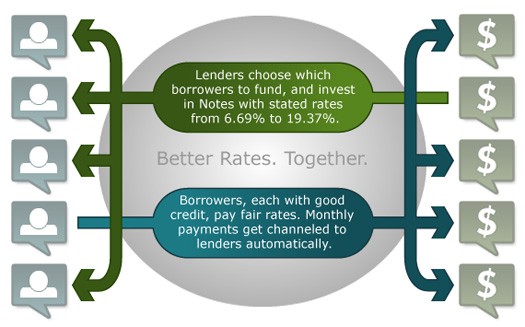
Peer-to-peer lending isn’t without it’s downside – and as with many traditional loans there are going to be plenty of people that default on their loans, and don’t repay. So you need to take that into account when choosing the loans you want to fund, and looking at the higher interest rates on riskier loans. The higher the interest rate that you’ll receive, the more risk you’ll take on. Also, Lending Club and other P-2-P sites are not available in all states.
Signing Up For Lending Club
I chose to sign up for Lending Club as my first foray into P-2-P lending because it has a pretty good reputation in the blogosphere, and elsewhere. They also successfully registered with the SEC in 2008, which has given them even more credibility.
Signing up for the Lending Club was a simple process, although it will take you a few days from signing up until you can actually begin lending. Here are the steps to sign up.
- Go to Lending Club web site
- Click on Join Now link at the top right of the screen and complete the application to be a borrower or investor on the screen that comes up. If signing up as an investor don’t forget to use the referral code below for $50 free!
- You should receive a confirmation email, in which you’ll need to click on a link to confirm your registration.
- Go back to the Lending Club website and login with your new login info.
- Click on the Invest button. Fill in your profile information in order to verify who you are, and to link your bank account to Lending Club. (Lending Club will make two small deposits into your account to verify that you have access to the account).
- Once your bank account is verified, go to the My Account tab, and then choose Add Funds. You’ll need to transfer at least $25 to your Lending Club account in order to get started. This may take a few days.
- From My Account tab, click on Invest to start lending money
Once you’ve finished to process above, you’ll be ready to start lending money. This is the fun part – lending money, and making a bit of money in return.
Lending Money With Lending Club
Lending money using Lending Club is actually kind of fun. You get to read about people’s situation, find out why they’re taking out a loan, and then see if they are in fact a good credit risk. I decided to look mainly at loans that were from borrowers with good credit scores, verified income, and what I considered good reasons for taking out a loan (I’m usually against taking on new debt of most kinds, so I didn’t want to fund loans unless they were for people bettering their debt situation, and trying to get out of debt). Since I’m just testing the waters, I decided to invest $100 for now. If I’m happy with the returns and borrower repayment I’ll consider investing more in the future.
Originally I was planning on investing my money with my friend Matt over at DebtFreeAdventure.com who is currently repaying a Lending Club loan to consolidate a couple of higher interest credit cards and an auto loan. Unfortunately (for me) his loan was completely funded before my deposit was credited to my LC account. So I had to find other loans to fund. To find borrowers to fund just do the following:
- Click on the Invest tab at the top of the page.
- Enter how much you would like to invest with each loan.
- Hit the Run LendingMatch button to match your lending amount to borrowers.
- If you would like you can increase the amount of risky loans you are willing to take on (and the interest you can make) using the slider on the page.
- When you are done hit the Next button and it will bring back a list of matching loans for you to invest in, based upon your risk tolerance that you’ve selected.
- If you prefer to select loans manually, you can also do that by selecting the Browse Notes link at the top of the page (this is what I chose to do).
Since I was investing with Lending Club for the first time I decided to manually select the notes that I would be investing in. I didn’t want to invest in anything that sounded overly risky, or to invest with anyone that sounded like they weren’t very responsible. Since I am only investing $100 to start, it didn’t take me very long to find 4 notes to invest $25 in, with people who had good credit scores, and who were either in the A or B credit rating.
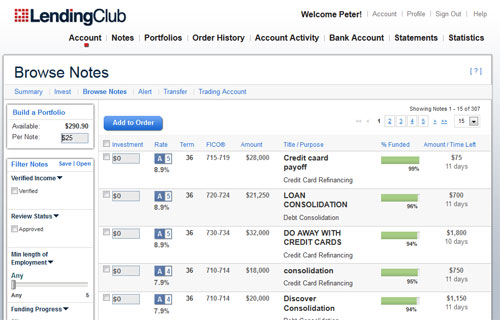
Once you have your notes selected you just click on the Invest button, and then confirm your purchase order for those loans, and those amounts. Piece of cake.
Now, I just have to sit back and watch the interest pile up!
Sign Up For Lending Club
I’m going to be charting my experience with Lending Club here on the blog, so stay tuned. If you’ve been thinking about signing up for an account, now is the perfect time. If you register for a new investor account and click on our link, for a limited time you’ll get $25 in your lender account – for free!
OK. Ready to sign Up For Lending Club And Start Investing?

(yes, that is an affiliate link. thanks for signing up through me!)
More Social Lending Resources
- Lending Club: My Review of Social Lending (From A Borrower’s Perspective)
- Lending Club Peer To Peer Lending (From A Borrower’s Perspective Again)
- Intro to Peer To Peer Lending
- How Is Your Lending Club Account Doing?
- P2P Lending Update
- 3 Years of Peer-2-Peer Lending
Have you entered into the peer-to-peer lending arena as a borrower or investor? What has been your experience?



Thanks for this post. It’s good to understand more about Lending Tree from an investing perspective. You really hit on something that I think would be important for me as a potential investor someday. I would want to be cautious about why the borrow is seeking a loan. I think helping someone get out of debt is a worthy cause if they have identified and corrected the root cause of their debt problems (overspending as an example). Of course sometimes the cause can’t be helped which is often seen with large medical bills. As with you, I couldn’t loan the money to help someone get into debt for material purchases. Great post!
Jason @ One Money Design´s last blog ..OMD QuickPress: Money Map Coaching
Thanks for the overview! I’ve avoided Lending Club because they had income and net worth restrictions for some time – and well, student loans do wonders for net worth.
It seems like that’s gone away though, so I’m interested in looking into it. I’ve dabbled in Prosper for a while until they went through their big government re-organization/authorization/whatever.
I understand your not wanting to “help” someone into debt, but this seems a lot like your bank or CU is doing, but this gives you (rather than a loan oficer at the bank) control over who the funds are going to, plus it’s giving you a bigger piece of the payback for making the loan in the first place. Seems like a “win-win” to me.
Like any other financial tools, P2P lending is just a tool that can be used well or badly. So far, I have been able to lend to more than 100 people on Lending Club and making a good 8% (after some defaults). The trick is weeding out those loans from people who are using it as yet another debt tool but not addressing the root cause of why nthey got in debt. I love reading the stories and interacting with the borrowers. This is something you can’t get at a bank or CU.
Peter,
Thanks for helping me better understand Peer to Peer lending. I see lots of upside, but, unless I am missing something, there seems to be a possible downside (at least for me): In my personal life I don’t loan money to friends or relatives. I think there is more to lose than gain, such as the friendship if they don’t repay. I try to help them in other ways and if I can afford it, I would rather give the money than loan it.
I realize that not everyone shares my philosophy, but isn’t loaning to friends through P2P the same thing? I am interested in your thoughts or your readers’ thoughts.
Joe Plemon´s last blog ..My Decision to Start Social Security Benefits Early
That is certainly something to consider, and in my personal life I do have that same policy of not lending money to family or friends. If I do give money it is with the expectation of not receiving anything in return.
I suppose I should be glad that Matt already had his loan funded because then I wasn’t able to go against my own policy. I guess i was thinking of if differently because it is through LC – but as you mention it really is the same thing. At least I know that Matt is working hard at getting out of debt bondage, and is doing his best to repay people quickly so he can be FREE!
As the the bible verse says, “the borrower is the slave to the lender”, and I certainly don’t want to be in that position with any of my friends or family because it does have a way of changing things. Thanks for the reminder.
Wojciech, according to their FAQ, Lending Club still has “state and financial eligibility” requirements. You have to live in one of 26 states and make at least $70,000 (or have a net worth of $250,000), more in California.
Will´s last blog ..I just found out I’m a green goddess
I’m a lending club investor and a Christian. I know that some Christians have issues with borrowing money at all, and some have issues with lending people money and charging interest for it. I would like to comment that using lending club to lower your interest rate on debt you already have and are trying to eliminate is very responsible and totally appropriate. I also don’t see anything wrong with helping someone by lending them money and charging them LESS than the bank would, especially when they are trying to restructure debt which lets them pay it off sooner.
I do want to caution potential investors on the point of choosing who they invest in. I originally invested in small business loans on lendingclub because I thought I would help people keep jobs and that’s good for the economy. I also have friends who have small businesses. I have so far lost money on lendingclub because the three loans that have defaulted have all been to small business (one was a B rated loan, the others C and G.) I now only loan to people who are restructering debt because I can see they have been making their payments(and so are more likely to have good credit,) and a smaller payment should be no problem and none of those have defaulted so far. As I add more loans, my losses should eventually go away from the profits from the good loans. I also look for smaller loans. It’s easier to repay 6000 or less in three years than it is to repay 18-25000 dollars. The businesses often request larger sums, so that may be part of why they seem to fail more in my experience. I don’t think some people really think about the fact that these are fixed term loans unlike credit cards which will let you rack up interest as long as you want. I just wanted to share what I’ve learned so far from my experience on lendingclub. I hope this is helpful to anyone. Even though I haven’t made money yet, I still like the idea behind lendingclub and I do recommend it to people. I feel like I’m helping people and making my money work for me at the same time.
Peter,
Thanks for your thoughts on my question.
Shawna,
I appreciate you sharing your experiences with P2P lending. I had questions on defaults that you answered.
Joe Plemon´s last blog ..My Decision to Start Social Security Benefits Early
@ Shawna
you said: “I know that some Christians have issues with borrowing money at all, and some have issues with lending people money and charging interest for it.”
Sadly, as a Prosper lender for several years, it also appears that many Christians also have issues with re-paying money. The amount of borrowers who come to Prosper under the cloak of “being good God-fearing, tithe-paying Christians” who end up walking away with the money is mind-numbing.
Turns of thiefs come in all types of varieties.
Prosper Lender´s last blog ..Re: Good read on the Prosper blog today: Debt Sales and Charge-off Collections
If you look around, you can get a $50.00 bonus for being ‘referred’ by somebody, so that’s a nice chunk of change to get started!
American Banking News´s last blog ..Bank of America Files Lawsuit Against Colonial BancGroup
As a note on the $70,000 income requirement: a friend of mine sent Lending Club an email, asking if that income requirement was for “household income” (as it is with credit cards) or individual income. They completely skirted the question in their answer to him, and said the information was self-reported:
“Thank you so much for your email. I wanted to touch base with you regarding your question. Most State regulations require that our Lending Members represent financial suitability standards to invest. This information is self reported.
Also, regardless of the requirement, you may still use the Note Trading Platform operated by Foliofn, a registered broker dealer. As a Trading Member, you will have the ability to buy and sell Notes that correspond to loans issued through the Lending Club website…” etc. etc. about the Trading Platform..
So, it’s anyone’s guess as to whether that $70,000 income requirement is household income or individual income. You would think it would be household, but I guess you can’t be sure.
I have used Lending Club for a while now. So far everything has been fantastic and the interest is mighty nice!
Lending Club is great! I can’t recommend them enough. I have had nothing but a great experience with the site and the rate of return that it offers.
Hank´s last post ..Understanding A Company’s Balance Sheet To Make You A Better Investor
Thanks for spreading this useful information Peter. You are right, there are always be borrowers who will default payments. And I think, as a creditor, you also need to do some personal background check to your prospective borrower to protect the fund you are about to lend.
Hey Peter,
Thanks for posting this overview. I haven’t ventured over to lending club yet, but noticed every PF blogger and their mother seems to be talking about it, so I felt like the odd kid out. Now I understand, much appreciated.
Ryan @ Planting Dollars´s last post ..Thank You Samurai and Cash Money Life
Thanks for the detailed writeup. I’ll be following how it goes for you and might test the waters myself.
Cents´s last post ..Selling Magazine Subscriptions for Income
It’s a great new concept, and definitely has a big future. There is one thing that everyone ignores: risk. Our economy is entering a period of dramatic change, and the previous rates of repayment are not indicative of what is going to happen in the future. Just as real estate lenders ignored the sub-prime dangers that were evident, anyone who lends money today may want to think of the consequences of a depression or dollar collapse on their lending portfolio.
Once we understand the risk involved, then I think it is a good idea to use peer-to-peer lending to make money.
George´s last post ..How to Tell if Your Boss is a Dinosaur
I am currently a member of Kiva to help others, but this looks like something that would benefit me as well. I will definitely look into it further
Ms. Freeman´s last post ..A Plea On Behalf of Haiti
I’m going to have to check that out. I know so many people love Lending Club. I need to do something different this year!
Mrs. Money´s last post ..It’s More Environmentally Friendly to Pay with Plastic
I was thinking of doing peer to peer lending because I was thinking about how I only have 8K of debt left to pay in 3 more months and how it’d be nice if a friend or family member would lend it to me at less than I pay now, and that would be more than they would be getting! :P Maybe once I get out of debt I will do Lending Club.
I have been reading about LC over the past few months on various finance related websites. I have been thinking of joining as an investor, but I noticed that my state was not included in the list of eligible states (as I live in North Carolina). Does anyone know if they will be opening this up to residents of other states to join anytime soon? Thanks!
Here today on a GOOGLE search using the words: Bible selling a house. My brother just told me how much it is costing us for the upkeep of the old homestead of our parents who died, and although we can afford it, me thinking how many others have to sell at a loss in this lousy real estate market because they don’t have that 3 to 6, or even 8 plus months (as mentioned above) saved up for not only the costs for the living, but dead too. The average house selling in #___ months. As a former landlord providing apartments for the working man, AND as a working man now with my own house, BUT after getting into that tenant class again AFTER being a landlord, and seeing how much it really takes these days to make ends meet, I decided to help out my retired friend and his son for the better part of last year in providing them a $1000 used motor home camping out at the campground for $1300 for the season instead of those $50 a night motel room expenses of last April ’09 of about a week or two before the campground opened. Them in the process of still trying to fix up their place even AFTER they won the court case to move back in AFTER the Town C.O.P. turned Health Officer ordered them out because of a leaking roof the major damage by a neighbor’s trees, and the insurance company taking almost forever to pay up, and still has NOT paid up! Now the electric company is refusing to turn the power on because of the bill his aunt accumulated before she died. What a mess! both in the place and the “system” up here in New Hampshire. Me looking to help out the homeless too, like a friend who’s a good carpenter (he helped build the addition to the Concord City Hospital a few years ago) who have these part-time jobs, like another man, the dishwasher at a local restaurant, but just don’t have enough for the what? $20/day for even that room in a rooming house, ($600 a month?) and when available, as the places taken over here by the Feds: them paying the refugees from other countries BEFORE even our homeless vets! Thus me signing up here right now to become a lender, and for any and all those in similar situations even with bad credit, but the money there weekly, to help you out, just let me know.
P.S. After reading the fine print that I thought was a joke, re: that of having to have $70,000 a year income, or was a past tense since corrected, but not, then sorry to those of you in that boat of a situation I did just write about. But maybe some good can come from such anyway. I’ll put myself down as a borrower, like to borrow maybe $2000 for a better motor home for the next guy in need, and offer my services to make sure that you find a qualified borrower here in New Hampshire. The man I spoke with Wednesday night as the local dishwasher for that restaurant saying that he had already checked out the Wal Mart situation of being able to camp out there in their parking lot for only a few days at a time, and so to play like musical chairs, or should I say: cars or vehicles. One such location that is really cheap is that $1.00 to get onto the highway to that Rest Area to spend the night there with the Truckers when the local Truck Stop is full. How can you beat that? For free at the State Park & Rides too, but from reading some stories in other states they seem to be cracking down on such repeat “business” because it’s major goal is for car-pooling of the public, and not to be used as a campground, even though you’re still not ON the ground technically, but #___ inches up therefrom in your motor home. You do pay for the plates and use of the roads AND these parking spots, and so maybe a temporary there too, and so off to location #3: I have a few ideas but prefer to keep quiet about them, because as they say: loose lips sink ships, or in this case, the motor homes. Feel free to send me an e-mail if you’re interested in such an investment. Hey! I’ll even guarantee it. I can put $2000 into a bank escrow account, and monitor the situation, and “if” the borrower doesn’t pay you back, I will under some buy-out option of the vehicle over to me, and you far away get the cash from the banker as escrow agent. Is there an attorney in the house? (;-) What about drawing up some such a contract? I have that pre-paid legal services of only about $25.00 off my credit card per month, that I’ve had since last Fall, and have yet to use these services, re: free analysis or draw-up of such an up to 10-page contract, and two free business letters, plus xx% off their regular hourly rate. Yours truly, JSH
I have just recently dipped my toes into the Lending Club waters. I have only purchased two notes. I anticipate purchasing more though, because I think I prefer people making payments to me as opposed to the treacherous world of the stock market.
Is the lender responsible for collecting? If so, how do they accomplish that?
Lending Club takes care of collections/etc. From their FAQ:
To try and avoid having borrowers go late or into default Lending Club only allows a certain set of qualified folks to even apply for a loan. Each borrower’s identify is verified via a social security number and other identification, like a driver’s license. Lending Club then checks that information against a borrower’s credit history – and then employment and income information is asked of the borrower, although not always verified by Lending Club. The ones that are verified are noted as verified.
For a better explanation of the collections process, check out this post.
Hi for the past 3 decades working through the bible & prayer & fasting I was lead in the Spirit to open a trust that will help all people not only Christians none christian s too in to a storehouse financing . It is just like the word of God says in the book of Acts,every one was larking non-thing they all sold what they had extra & shard it with one another.As all this is just in my devotions making every note as the Holy Spirit proponent me.Well it has being a very long time & shard the visions with many meany christian but they all think it will never work .Pleas if you do have some in sight of this do let me know ,as the concept is from the book of genesis .The story of Joseph as one of my roll men . Thakyou Anthony.